by Alan Kennedy
The 7th iteration of this event took place in beautiful Santa Ynez Valley, north of Santa Barbara, in California, USA, May 13th – 15th.
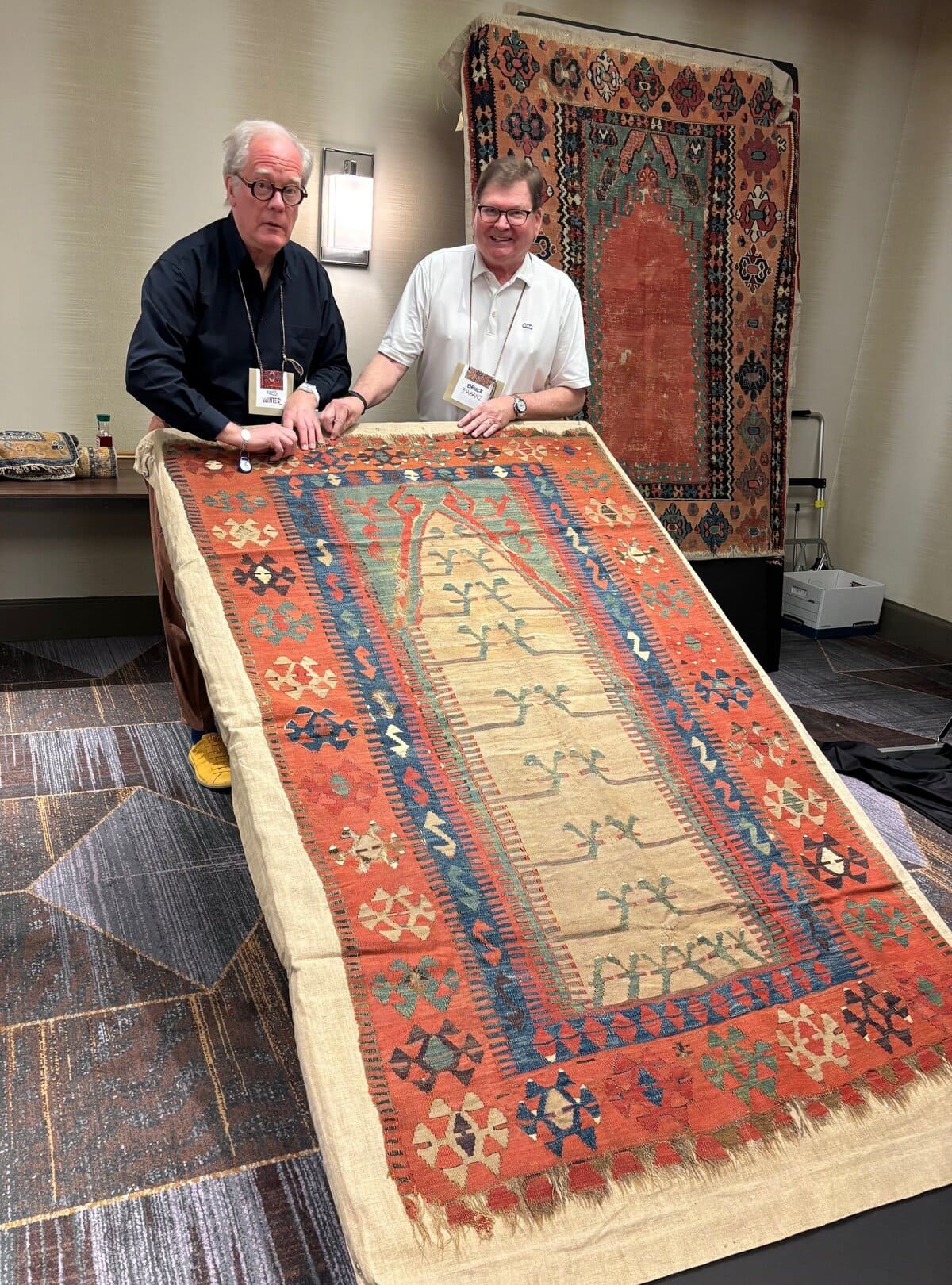
Most of us feed our interest in carpets and textiles by way of a screen. We look at auction catalogues, websites, facebook pages, Instagram, digitized articles and other content on a screen, and use emails to send each other images of our fiber friends. It’s convenient, free and easy. Why would we get on a plane, carry carpets and textiles with us, pay for a hotel and registration fee, rent a car and spend a few days sharing our interest and passion in these items that we cherish?
That’s exactly the point of Carpet & Textile Forum, organized by Brian Morehouse, Bethany Mendenhall, and Stephanie Morehouse.
The 2025 edition had something for everyone, and not by way of Powerpoints shown in a darkened room, on another type of screen. We mean the real thing, showing actual pieces while explaining them to the almost one hundred attendees. What could be better than seeing them in person, looking at the back of each one if we wish, and learning in a hands-on way.

Carpets have always been the predominant subject matter of the presentations, however this year there were two showings of world-class textile collections. One was by Julfi Ali (with Jim Burns and David Reisbord), who brought their collections of moon shawls that were woven in Kashmir, primarily in the 19th century. They feature a design with a large oval central medallion, and four quarter medallions inside the borders at the four corners of the textile. The shawls were finely woven using the rarest animals hairs, and were worn in both Asia and the Western world.
The program opened with Bruce Baganz showing a very interesting collection of the early Anatolian Kilims that will be shown in a future museum exhibition.
A pre-Columbian South American textile collection, formed over the course of several decades by Jed Smith, consists of small bags that were used to hold cocoa leaves, and long rectangular bags for arrows. The variety of textile techniques, patterns, and fibers used to make these containers represent the artistic works of several cultures that span millennia.
Both presenters of the textile collections were younger than the predominant age group of the attendees. This is encouraging, as there is a need for younger generations.

The carpet presentations included two collections of small-scale knotted Chinese mats & chair-backs of Hillary Dumas and Stephanie Morehouse. These examples are perhaps the least-studied area in the world of rugs, so it was a treat to see numerous examples from the East.
So-called Baluchi rugs, as explained by Bob Bell, are somewhat of a misnomer. Who actually were the Baluch people, where did they live, and what did they weave? These questions were posed, and intelligently discussed by the speaker, bringing attention to the fact that the labels we commonly use for various types of carpets often need to be reconsidered.
This brief account omits details of other interesting sessions, such as: “What the Hell Is It,” with mystery’ carpets and textiles; the popular “Show & Tell;” as well as the dealer show, which took place in another meeting room of the hotel. The tentative date for next year’s C&TF is in April, so clear your calendars!
Alan Kennedy